January 2022

Archive for January, 2022

Exercise and Learning

Sunday, January 30th, 2022

iStock_000015228876Small

Children love to go outside and run around. Suppose you learned that spending less time in the classroom and more time on the playground would result in kids getting better grades and better test scores?

Probably the most important and exciting discoveries of the past few decades. Movement and exercise promote all kinds of learning and, in fact, are vital for learning. Children running around a playground are not just taking a break from class. They are not just reducing their level of stress. Physical activity is promotes all the brain functions which are needed for learning to occur.

Carla Hannaford in her important 1995 book  Smart Moves: Why Learning is Not All in Your Head cites a study in which 500 Canadian children who spent an extra hour or more each day in gym class, performed notably better on exams than less active children. This book is as important today as it was when it was published almost 20 years ago.

John Ratey in Spark the Revolutionary New Science of Exercise and the Brain (2008) described studies by the California Dept of Education showing that students with higher fitness levels also had higher test scores. In fact, a panel of researchers doing a review of over 850 studies, concluded that exercise has a positive effect on memory, concentration and behavior. They recommended that all children participate in at least one hour of physical activity each day.

Why is this true?

On one level, it is easy to see why exercise would help the brain to function better. Exercise sends more blood, oxygen and nutrients to the brain, which would naturally help it to work. But it goes beyond this. It has been learned that exercise causes the brain to produce BDNF, a neurotransmitter that is necessary for learning to occur. Without exercise the brain and body become sluggish and are unable to do their best. This is even more important for children who are having trouble in school. Movement and exercise will help their brains to function at peak capacity.

What can I do?

A reasonable amount of exercise every day is beneficial for children to learn in school. Daily gym and frequent breaks to allow them to move and stretch are important. After school, before sitting to do homework (or watch TV) it is best to let them out to get a healthy dose of exercise. In the springtime this is very easy to do. Usually this is what they want to do and this is because, intuitively, their bodies know what they need.

This goes for adults, too, by the way. Daily exercise which you can enjoy, even just a walk around the block, is crucial, especially for those of us with sedentary occupations. A reasonable amount of regular exercise is a win-win solution for everyone.

Group of five happy children jumping outdoors.

Sources

Hannaford, Carla, Playing in the Unified Field: Raising and Becoming Conscious, Creative Human Beings (2010) Salt Lake City, Utah: Great River Books

Ratey, John J., Spark The Revolutionary Science of Exercise and the Brain (2008) New York, NY: Little, Brown & Co.
Play and Brain Development

Wednesday, January 12th, 2022

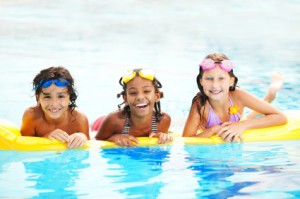
Smiling children in pool.

How many of us remember the feeling of leaving the building on the last day of the school year – a feeling of freedom, anticipation, and excitement! What does a summer of fun and unstructured time mean to children and teenagers on summer vacation: Does it mean that all learning goes on hold until September, while they go out and enjoy themselves? Not at all.

There is a great deal of learning that goes on in everyday life, when youngsters are running around, interacting with each other and playing games.  They are learning social skills, how to take turns, how to resolve conflicts, how to communicate and make friends, to name just a few. To have the free time to use any way they wish gives them valuable practice managing their own time. They may learn some decision-making skills as they decide whether they want to do this or that activity on a given day. Many of these would not usually be learned in a classroom, because the time there is structured and planned for them. Play is healthy precisely because it is unstructured and unplanned, allowing for the development of spontaneity and different kinds of learning and creativity.

But play is even more important than this. In a major study, children who spent 40 minutes a day in active games and tag made the greatest improvement on standardized tests. They significantly improved their ability to learn, organize, think abstractly, and control their behavior. No wonder the American Academy of Pediatrics, in November, 2006, strongly recommended free, unstructured play as healthy and essential for the development of things like coordination, focus, resiliency, and reaching appropriate developmental milestones.

We all know that physical activity is healthful for both the body and the mind. But even playing board games or word games is good exercise for the brain, and helps it to grow.  There is a tremendous amount of learning that goes on outside the classroom, in everyday life, especially for growing kids (of any age!), and these are lessons and skills they will need for their entire lives.

According to teacher and educator Linda Verlee Williams, “When children build a birdhouse or play a strategy game…they are using high-level nonverbal thinking – planning, visualizing, predicting – which will serve them well in school and beyond.”

Pretend Play

Children have always enjoyed pretending, and “pretend play” has been found to be very important for children’s social, mental, emotional, and even academic development.

When children pretend, they are using their imaginations, which requires that they symbolically substitute one thing for another. A box becomes a boat or a car; a flat rock is a plate, or a piece of pie; a doll is a baby. This use of imagination assists children in learning to think abstractly, because they are holding an image in their minds, and mentally transforming it into something else. This can be linked to later creativity and problem-solving.

When children pretend-play together, they learn to take a different mental perspective than their own; they recognize and act out emotions, motivations, cause-and-effect, and many other concepts. In addition, there are obvious social benefits playing with other children and/or acting out roles that they may one day take on, such as policeman, mommy, daddy, teacher, and others.

Any kind of play is good

Indoors or outdoors, all kinds of games are good for stimulating the mind to think. Board games and card games of any kind keep the hands moving and keep the players thinking. Jigsaw puzzles, crossword puzzles, word searches and the like, can help adults to keep their minds alert and young.

Some of us are old enough to remember simple games and toys like “jacks,” “tiddly winks,” “pick-up sticks,” and marbles. Did anyone know while we were playing these that we were improving eye-hand coordination and other psychomotor skills which are important for everything from writing to using tools?

So when you see your kids outside “just” playing, you can feel good about what they are doing. We would do well to imitate them in their fun. This is a win-win solution for everyone!

Sources

www.aap.org/stress